

Reverse Engineering from Business Outcomes
Start at the end. Work backwards. Deliver with certainty.
Most technology projects start with a product and work forward to justify it. We start with the business outcome and work backwards to determine the right solution. This reverse-engineering approach is applied to every engagement we deliver — supply chain, IT, AI, and technology — and it is the single biggest reason our projects deliver what they promise.
Talk to UsWhy Start at the End?
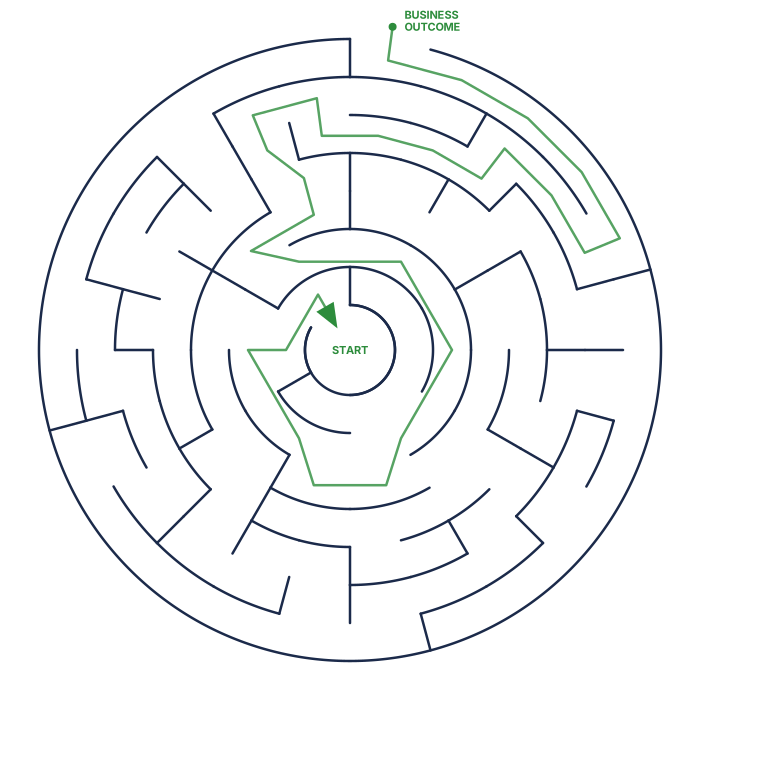
Think of a children's maze. If you start at the entrance, you'll hit dead ends, backtrack, and waste time — and you might not finish at all. But if you start at the exit and trace the path backwards to the entrance, the solution is obvious. Once you have the path, you can predict how long the journey will take and have certainty of success.
That's how we approach every engagement. We define the desired business outcome first, then work backwards through what needs to be true for that outcome to be achieved. The result: a clear plan with predictable cost, predictable timeline, and high certainty of delivery.
Traditional “best effort” approaches — starting with a product or a technology and working forward — risk dead ends, scope creep, and results that don't match what the business actually needed.
Our Seven-Step Process
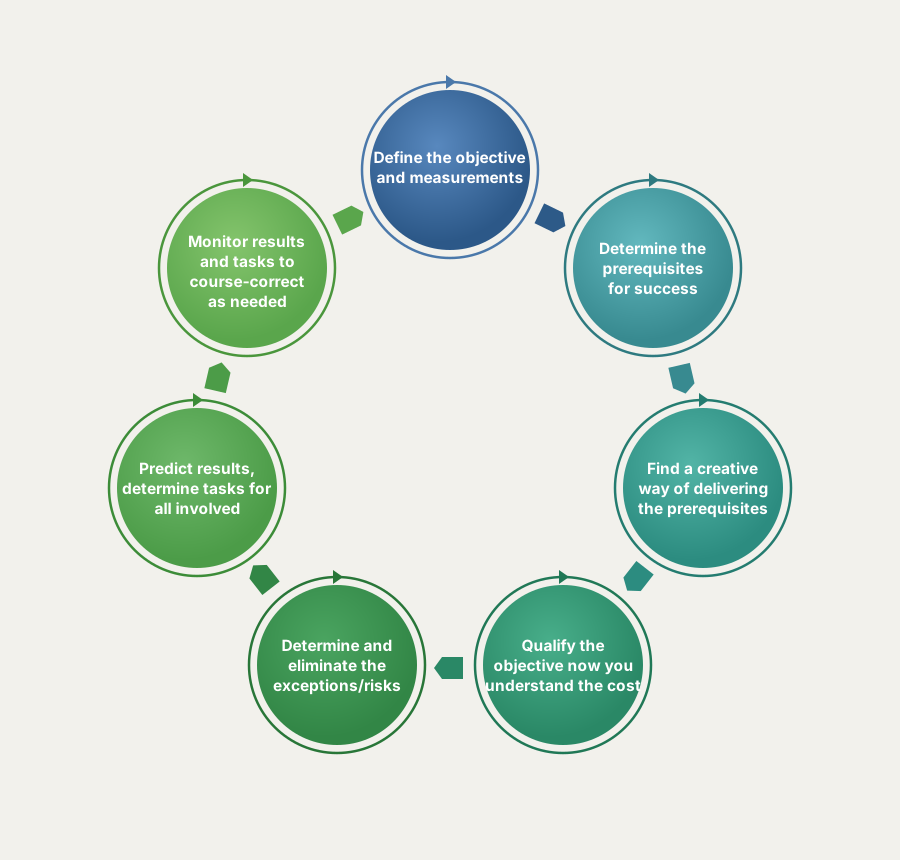
Every engagement follows the same seven steps. The process is cyclical — each step incorporates iterative refinement, and we return to earlier steps as understanding deepens.
1Define the Objective and Measurements
Start with the end. What does success look like, and how will we measure it? We work with your leadership team to establish clear, measurable business outcomes — not technical specifications, but the business results you need to achieve. This is the most important step: if we get this wrong, everything that follows is wasted effort.
2Determine the Prerequisites for Success
What must be true for the objective to be achieved? This is where we map the dependencies — people, process, technology, data, governance, and timing. We look at what exists today, what needs to change, and what’s missing entirely.
3Find a Creative Way of Delivering the Prerequisites
This is where experience matters. There are usually multiple ways to deliver the prerequisites — some expensive, some fast, some elegant. We draw on our cross-domain experience (supply chain, IT, AI, IoT) to find the approach that best fits your constraints, timeline, and budget. Sometimes the answer is a different technology than the customer expected. Sometimes it’s no technology at all.
4Qualify the Objective Now You Understand the Cost
With the prerequisites and delivery approach clear, we revisit the objective. Is it still worth pursuing at this cost? Does the business case hold? This is a deliberate checkpoint — it prevents organisations from committing to projects that don’t justify the investment, and it builds trust because we’re willing to say “this doesn’t stack up.”
5Determine and Eliminate the Exceptions and Risks
What could go wrong? We identify the risks, edge cases, and exceptions — and eliminate or mitigate them before they become problems. This includes technical risks, organisational risks, change management risks, and vendor risks. We are comfortable taking a shared-risk approach to engagements because this step gives us confidence in the outcome.
6Predict Results and Determine Tasks for All Involved
With the path clear and risks managed, we can predict the results with high confidence and define the specific tasks — for us, for your team, and for any third parties. Everyone knows what they’re responsible for, what the timeline looks like, and what the expected outcome is.
7Monitor Results and Tasks to Course-Correct as Needed
Delivery is not set-and-forget. We monitor progress against the predicted results and adjust as needed. The cyclical nature of the process means we return to earlier steps when circumstances change — re-qualifying the objective, reassessing risks, or finding a different delivery approach. The goal is the business outcome, not rigid adherence to the original plan.
How This Fits Our Methodology
The reverse engineering approach operates within our broader ALIGN → PILOT → SCALE-UP methodology:
We apply the full seven-step process to define the objective, map the prerequisites, find the delivery approach, and qualify the business case.
We apply it again at a smaller scale — reverse-engineering from the pilot’s success criteria to ensure even the first short-cycle delivery is outcome-driven.
The seven steps guide each expansion decision — qualifying whether the next phase of investment is justified by the evidence from the previous one.
The reverse engineering approach is how we think. ALIGN → PILOT → SCALE-UP is how we structure the engagement. Together, they ensure every step is grounded in business outcomes, not technology for its own sake.
Learn more about ALIGN → PILOT → SCALE-UP →Frequently Asked Questions
What is reverse engineering in consulting?+
Reverse engineering in a consulting context means starting with the desired business outcome and working backwards to determine what needs to change — people, process, technology, data, and governance — to achieve it. Synergic Technologies applies this approach to every engagement: supply chain, IT, AI, and technology. It’s the opposite of starting with a product or technology and working forward to justify it.
How does reverse engineering reduce project risk?+
By defining the objective and working backwards through prerequisites, costs, and risks before committing to delivery, reverse engineering eliminates the most common causes of project failure: unclear objectives, underestimated dependencies, and solutions that don’t match the actual business need. Synergic’s seven-step process includes a deliberate qualification checkpoint (Step 4) where we assess whether the project still makes business sense once the true cost is understood.
What is the difference between ALIGN PILOT SCALE-UP and reverse engineering?+
They’re complementary. Reverse engineering is how Synergic Technologies thinks — starting with the business outcome and working backwards to determine the right approach. ALIGN → PILOT → SCALE-UP is how we structure the engagement — aligning on strategy, proving value through a pilot, and scaling from evidence. The reverse engineering methodology is applied within each stage of ALIGN → PILOT → SCALE-UP.
Every Engagement Starts With the Outcome
Tell us what you're trying to achieve. We'll work backwards from there.
Talk to Us