
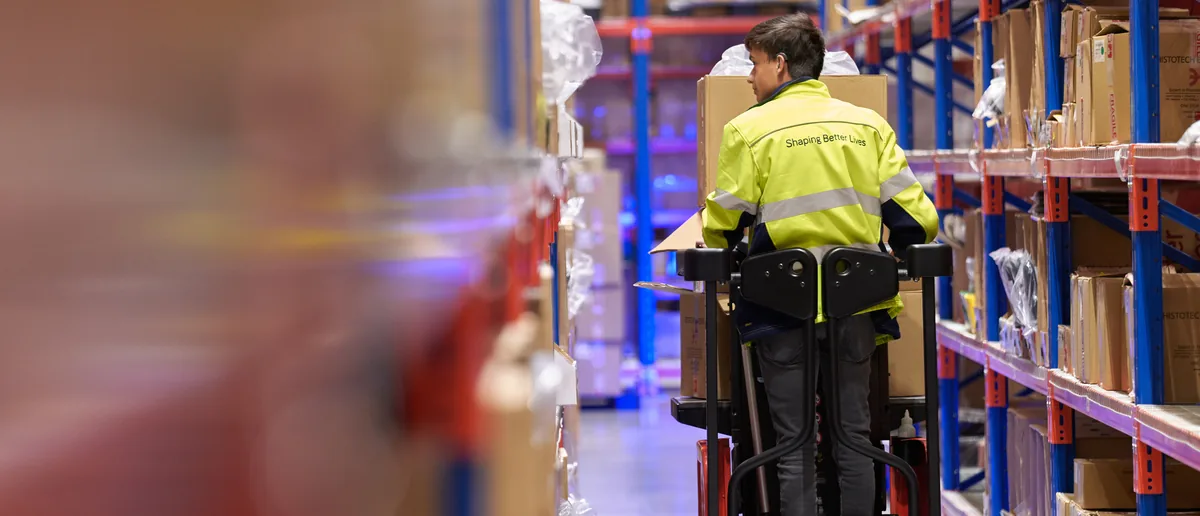
Medifab makes mobility and assistive equipment for people who depend on it arriving correctly and on time. For over three decades its picking and dispatch ran on barcode scanning, checklists, data entry and paper order sheets with handwritten serial numbers. The process had served the business well, but order volumes, product ranges and international sites were all growing.
Medifab brought the problem to Synergic Technologies. We recommended RFID, then designed and delivered it with Zebra hardware and MotionWorks™ Enterprise software — starting by mapping where RFID could take a manual task away entirely, and where it could simply make a slow task fast. Picking moved to the new workflow in December 2024, dispatch followed in 2025.
Medifab now reports picking time down by more than 50%, near-perfect dispatch accuracy, and orders verified in 10 seconds.
At a Glance
- Client
- Medifab
- Delivered by
- Synergic Technologies (Zebra partner)
- Industry
- Medical equipment manufacturing
- Location
- Canterbury, New Zealand
- Scope
- Picking, dispatch verification, inventory visibility
- Software
- Zebra MotionWorks™ Enterprise
- Hardware
- Zebra FX9600 fixed RFID reader, MC3300 RFID mobile computers, ZT400 printers
- Live since
- Picking December 2024, dispatch 2025
Medifab designs and manufactures wheelchair accessories, rehabilitation equipment and mobility solutions from New Zealand, supplying customers here and internationally under the promise “Shaping Better Lives”. The outcomes on this page are as published by Zebra in its customer-approved success story.
The Challenge
Medifab set out to find a more efficient picking and dispatch process, with automated verification and real-time inventory visibility. Several things stood in the way:
- Picking and dispatch had run for over three decades on barcode scanning, supported by checklists, data entry and paper order sheets with handwritten serial numbers.
- Order volumes, product ranges and international sites were all expanding, and Medifab wanted products and orders verified faster with the information captured automatically.
- Verification depended on people writing things down — and a handwritten note cannot prove what was actually shipped.
- Product movement was not captured automatically, so locating a misplaced item meant a visual search of the warehouse.
- When a customer reported a missing item, Medifab resolved it by replacing the item, because the paper record could not confirm what had happened.
- Real-time inventory visibility was needed across both picking and dispatch, not just at stocktake.
The Solution
Synergic recommended the RFID approach, designed the workflow around the tasks that needed to change, and delivered it with Zebra hardware and MotionWorks Enterprise. The result is a picking and dispatch process where verification happens automatically, at the point the work is done.
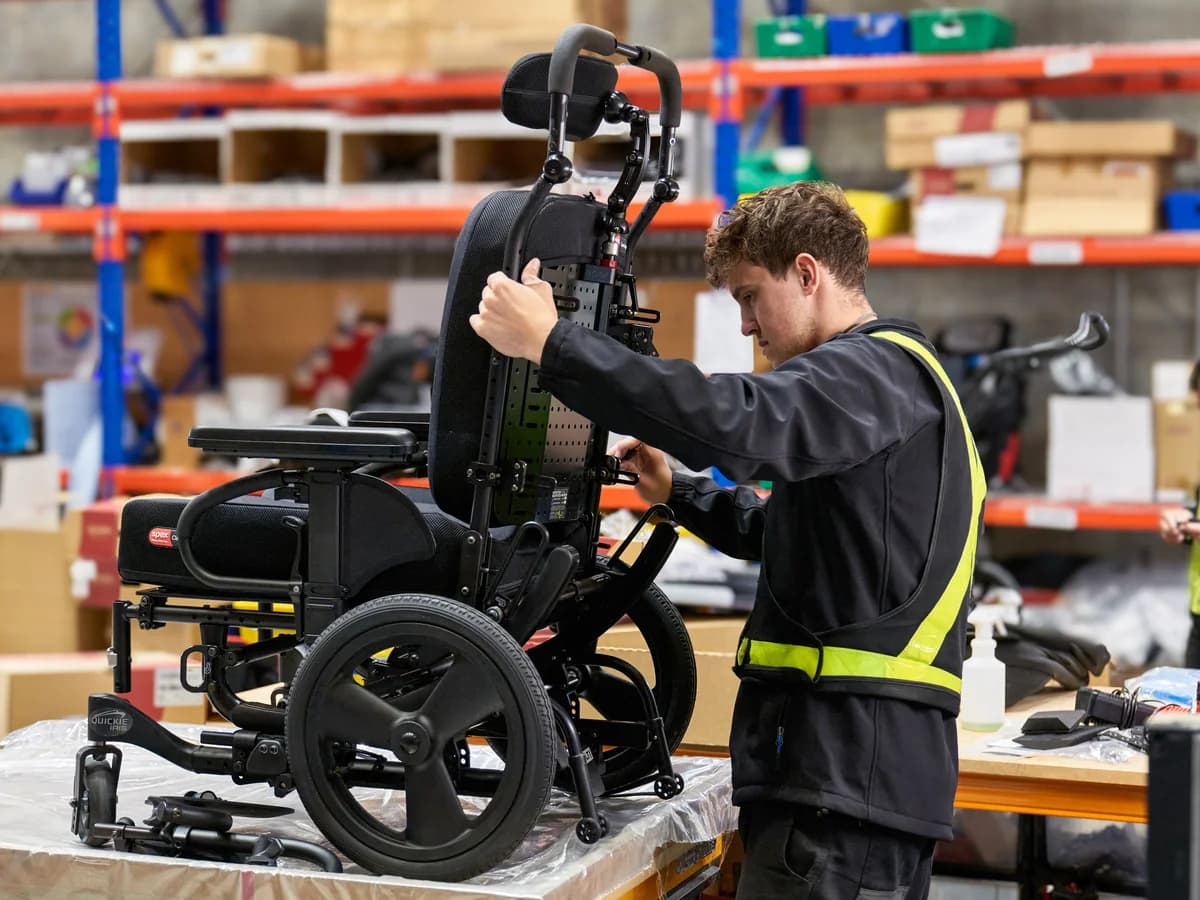
Synergic recommended RFID, then delivered it
Medifab brought the problem to Synergic. We recommended Zebra’s RFID system, then mapped out where RFID could take a manual task away entirely and where it could make a slow task fast with minimal human input — rather than automating the process as it stood.
RFID-guided picking
A picker assigns themselves a job in the ERP, replacing the previous manual sign-off. They collect an MC3300 RFID mobile computer, which shows each order and the location of every item and directs them to the correct product.
Labelling at the pack bench
Once an order is collected and packed, its RFID shipping label is printed on a ZT400 Series industrial printer at the point of packing.
The nesting station
Packed orders go into a shielded box fitted with an FX9600 fixed RFID reader. One button press confirms whether all the correct products are inside, updates the system automatically and flags anything missing or extra — a formal completeness check that takes 10 seconds.
One inventory picture in MotionWorks Enterprise
MotionWorks Enterprise collects data from every reader in circulation into a real-time inventory ecosystem. Every tag is tracked in the ERP with its last-seen location — an aisle, the nesting station or a door — so inventory accuracy follows dispatch automatically.
Onboarding the warehouse team
Medifab’s integrations engineer worked with team leaders to write a work instruction and familiarise every warehouse employee with the new devices. Trust in the system came quickly once staff saw it could prove when an item had been handled and find a missing one fast.
The Results
Picking time cut by more than 50%
A job that once took 10 to 15 minutes is now completed correctly in about five. The workload on warehouse teams eased almost immediately, freeing time for higher-value work.
Near-perfect dispatch accuracy
Every order is verified at the point of packing, in 10 seconds, before it leaves the building. Medifab reports near-perfect dispatch accuracy across every shipment since RFID went in.
Serial and lot history on every product
Every product movement is now on record, creating accurate serial and lot histories. That makes quality investigations, recall management and tracing an item back to its point of manufacture far easier — a benefit Medifab did not anticipate at the outset.
Customer queries settled with evidence
A verified dispatch record replaces handwritten notes, so a reported missing item can be checked and answered rather than replaced. Queries resolve faster and unnecessary replacements are avoided.
A warehouse move de-risked
When Medifab consolidated into a new warehouse near Christchurch in 2026, all goods were moved through an arch of Zebra RFID readers. Medifab knew exactly which items had moved and could close the old facility down in the system with confidence.
What Comes Next
Medifab is refining the processes it has before scaling further. Next on its list is visibility over all products, and automating dispatch with RFID readers on the warehouse aisles and doors — continuing to reduce manual data entry, improve inventory accuracy and streamline warehouse operations.
Read Zebra’s Success Story
Zebra published its own account of this deployment, with Medifab’s approval, naming Synergic Technologies as the implementation partner.
Published September 2026 through the Zebra Customer Advocacy Program. Outcomes and quotes on this page are Medifab’s own, as published by Zebra.